
The Global Ocean Forum at the Third Session of the BBNJ Agreement Preparatory Commission

The Global Ocean Forum attended the Third Session of the BBNJ Agreement Preparatory Commission (23 March to 2 April 2026) from 23 to 28 March held at United Nations Headquarters in New York, New York, USA. In close collaboration with partners under the Common Oceans Cross-sectoral Project (CSP), the Global Ocean Forum progressed key activities under the CSP with a focus on strengthening engagement with national and regional stakeholders attending the first week of the Third Session of the BBNJ Agreement Preparatory Commission (BBNJ PrepCom III).
Stakeholder Consultation on the Common Oceans Cross-sectoral Project (CSP)

The CSP organized a side meeting during BBNJ PrepCom III on 26 March hosted by the Permanent Mission of Chile to the United Nations in New York. This meeting served as an opportunity for BBNJ community stakeholders to discuss the CSP’s latest activities in its two pilot regions, the Southeast Pacific and Pacific Islands. These included the results of a capacity needs assessment on ABNJ governance, a capacity building program to strengthen the ability of national practitioners to implement cross-sectoral ABNJ governance, and the development of an ABNJ Governance Platform as a job aid for ABNJ actors. The CSP team also introduced a new virtual working group focused on collaborative mechanisms in ABNJ management and highlighted an upcoming short e-Learning course on that aims to raise public awareness of ABNJ.
Commencement of the GEF-funded project “Global and regional support to the BBNJ Agreement ratification process and implementation readiness”
The Global Ocean Forum had the opportunity to participate in two events organized by the UN Food and Agriculture Organization (FAO) in partnership with the UN Environment Programme (UNEP) and the UN Development Programme (UNDP) to mark the commencement of the GEF-funded project “Global and regional support to the BBNJ Agreement ratification process and implementation readiness” (GloReBBNJ Project). The Global Ocean Forum will serve as the executing agency for the UNEP-led outputs of the GloReBBNJ Project.

On 25 March, the Global Ocean Forum attended the BBNJ Global and Regional Project Reception at UNDP Premises. Speakers from UNDP, FAO, UNEP, and the UN Division for Ocean Affairs and the Law of the Sea (UN DOALOS) provided an overview of the GloReBBNJ Project and the support it will provide to ratification and implementation of the BBNJ Agreement.
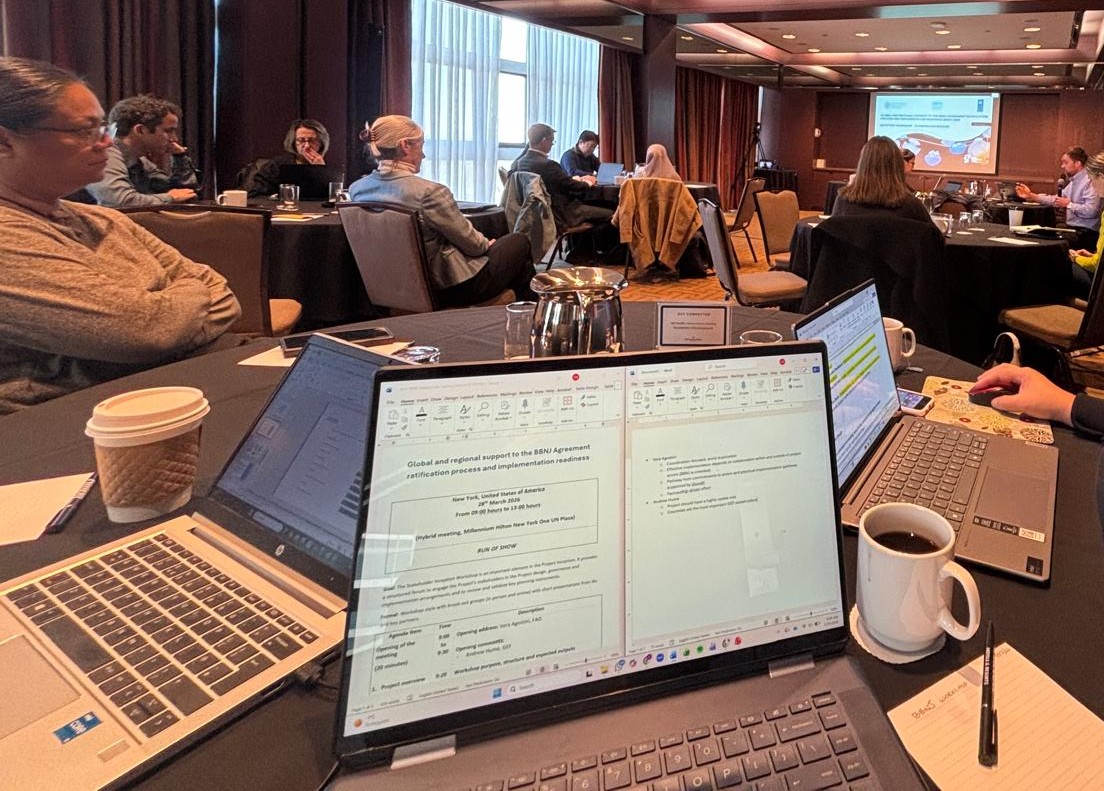
On 28 March, the Global Ocean Forum attended the Stakeholder Inception Workshop of the GloReBBNJ Project, a hybrid event designed to allow project partners and stakeholder from regional organizations and countries implementing the BBNJ Agreement the opportunity to discuss the project objectives and contribute to the design of project implementation.
BBNJ First Movers
The Global Ocean Forum was invited by the Chilean Government to join an in-person meeting of the BBNJ First Movers on 28 March as a Strategic Partner. The BBNJ First Movers are a government collaborative committed to fast-tracking the creation of high seas MPAs in priority biodiversity hotspots. Supported by scientists and non-governmental organizations, the BBNJ First Movers aim to have MPA proposals ready for consideration and adoption by the first meetings of the BBNJ Agreement Conference of the Parties, which will be held from 11 to 22 January 2026 at UN Headquarters in New York, New York, USA.
During this meeting, Dr. Miriam Balgos, Executive Director of the Global Ocean Forum, delivered remarks on behalf of the CSP. She provided an overview of the key activities of the project and its efforts to build capacity for cross-sectoral ABNJ management and governance in its two pilot regions, the Southeast Pacific and the Pacific Islands,
The Global Ocean Forum at the UNFCCC COP30
COP30 Virtual Ocean Pavilion

Partners from across the globe are thrilled to welcome all to the COP30 Virtual Ocean Pavilion, which will be open from 3 to 21 November with on-demand access from 22 November to 22 December. Register for free to experience the many features on offer, including live events and exhibitions, and receive daily updates from the COP in Belém.
This free online platform is dedicated to raising the visibility of the ocean and showcasing why the ocean matters in climate negotiations and to all life on our planet. It aims to democratize the ocean at UN Framework Convention on Climate Change (UNFCCC) Conferences of the Parties (COPs) and promote unity and inclusivity while increasing knowledge, commitment, and action for the ocean-climate nexus at key events during the UN Climate Conference (COP30), held in Belém, Brazil from 10 to 21 November 2025.
Now in its fifth iteration, the Global Ocean Forum is returning as a co-organizer of the Virtual Ocean Pavilion in collaboration with Plymouth Marine Laboratory and Ocean Generation, with additional support from 27 sponsors and partner organizations. Learn more about the Pavilion here.
UNFCCC COP30 Side Event

The Global Ocean Forum was the lead organizer for an official COP30 side event on Strengthening capacities to enable beneficial interplay among climate, nature, and human systems, held on Wednesday, 19 November from 11:30 to 13:00 Brasilia Time (GMT-3) in Side Event Room 1 of the Blue Zone. This event was co-organized by the Urban Coast Institute-Monmouth University; Nausicaa Centre National de la Mer, France and World Ocean Network; and Centre for International Law, National University of Singapore.
This panel discussion explored the opportunities and challenges of innovative conservation and sustainable use efforts that:
- Address climate change and biodiversity loss through enhanced capacity building and harmonized governance frameworks.
- Strengthen the contribution of ocean ecosystems to climate change mitigation and adaptation.
Panelists shared information on proven practices and valuable insights derived from recent and ongoing innovative efforts that aim to strengthen the contribution of ocean ecosystems to climate change mitigation and adaptation.
2024-2025 ROCA Report

The Global Ocean Forum (GOF) released the 2024-2025 edition of the Roadmap to Oceans and Climate Action report (ROCA Report), Assessing Progress on Ocean and Climate Action, on 14 November 2025.
The 2024-2025 ROCA Report is a collaborative, multi-organizational effort, involving 70 authors from 45 organizations, and serves as a crucial resource for party negotiators and non-Party stakeholder representatives attending UNFCCC COP30. The report comprehensively takes stock of progress in implementing the ocean and climate agenda at the COP, across other global policy platforms and processes, and through regional and national initiatives. The report identifies gaps in information and policy that require attention and provides recommendations for future action at a critical time for the ocean-climate nexus.
Access the full report and find more details on the ROCA website here.

The Global Ocean Forum co-organized a side event at the second session of the BBNJ Agreement Preparatory Commission (BBNJ PrepCom II) with the World Maritime University-Sasakawa Global Ocean Institute (WMU-GOI), supported by additional partners. The event, titled Ratifying and Implementing the BBNJ Agreement: Efforts and Challenges, was held in Conference Room 1 of the United Nations Headquarters in New York on Thursday, August 21 from 13:15-14:30 during the first week of BBNJ PrepCom II.
The side event brought together key leaders and experts working in SIDS and other developing countries working towards ratification of the BBNJ Agreement to showcase the efforts and challenges of domestic implementation, as well as lessons learnt. Key topics included aligning domestic policy and legislative implementation with BBNJ Agreement obligations, integrating indigenous knowledge into implementation, regional actions, and maximizing effective use of the Agreement’s bodies.
This event also highlighted the need for cross-sectoral, multi-level, and inter-generational collaboration and coordination as well as ongoing advocacy and capacity development activities that would help advance the Agreement’s ratification and future implementation. These include the Global Environment Facility-funded Common Oceans Cross-sectoral Project and Enabling Activities to support the ratification and early implementation of the BBNJ Agreement (EA-BBNJ), and initiatives of the Interamerican Association for Environmental Defense (AIDA) and the Office of the Pacific Ocean Commissioner (OPOC), among others.
View the full event programme, including the complete list of side event partners and speaker biographies, here. A summary of the event is available here.

The third United Nations Ocean Conference (UNOC3) was held in Nice, France from 9 to 13 June 2025. The conference was co-organized by France and Costa Rica and brought together UN member states, their heads of state and government, international agencies, local authorities, civil society, the private sector, and international donors. UNOC3 was focused on accelerating action and mobilizing all actors to conserve and sustainably use the ocean and will seek to support the implementation of Sustainable Development Goal 14 (SDG14).
The Global Ocean Forum co-organized a Blue Zone side event in collaboration with the International Science Council, Université Côte d’Azur and other partners titled Bridging Science, Policy and Action: Enhancing cross-sectoral collaboration for inclusive and equitable ocean management and governance. The side event was be held on Friday, 13 June from 12:15-13:30 in Room 5 of the Blue Zone conference venue.
In alignment with the Blue Zone event theme, the Global Ocean Forum launched a Voluntary Ocean Commitment in March 2025 to accelerate and contribute to the implementation of SDG14 in collaboration with the Interamerican Association for Environmental Defense, Monmouth University-Urban Coast Institute, Nausicaá National Sea Centre, and other partners.
Learn more about the GOF participation at UNOC3 here.

On Tuesday, March 4, 2025 at 12PM EST / 6PM CET a panel discussion on Sustainable Blue Economy was held as the final installment in the Ocean and Climate Action webinar series jointly organized by Monmouth University Urban Coast Institute and the Global Ocean Forum. The webinars aimed to mobilize civil society around critical ocean and climate action identified in the reports on Assessing Progress on Ocean and Climate Action (ROCA Reports). The ROCA Reports are published biennially by the Global Ocean Forum and serve to review global progress made on climate and ocean initiatives. The third Ocean and Climate Action webinar focused on the need for a regenerative blue economy to support healthy ocean and climate systems, which was highlighted by the 2022-2023 ROCA report. Panelists discussed sustainable ocean planning, the advancement of blue economy practices, and the development of a sustainable and regenerative blue economy.
The High-Level Panel for a Sustainable Ocean Economy aims to achieve 100% sustainable management of member countries’ ocean areas under their national jurisdictions by 2025 for original members and by 2030 for new members. Sustainable ocean plans are guided by a comprehensive framework that includes recommendations for marine protection and utilization over the next decade to manage humanity’s impacts on the ocean through transformative actions. Sustainable ocean planning is pivotal in addressing the 10 Ocean Decade Challenges for collective impact and in advancement of a more prosperous and resilient future for people and the planet. An Ocean Decade Programme on Sustainable Ocean Planning (SOP) is under development to support the journey towards knowledge-informed planning, conservation, and sustainable use of the ocean areas under national jurisdiction while also promoting transboundary cooperation. The World Bank has been supporting integrated and sustainable economic development in a healthy ocean through its Blue Economy Program and PROBLUE, an Umbrella Multi-Donor Trust Fund launched in 2018 designed to help countries chart a course towards a Blue Economy approach. This webinar provided a platform to discuss implications to government and non-State actors in building a blue economy that utilizes ocean and coastal resources while emphasizing economic growth, social inclusion, and environmental preservation.
Panelists:
- Cynthia Barzuna, Ocean Action 2030 Coalition Director, World Resources Institute
- Cary Anne Cadman, Caribbean Blue Economy lead, World Bank
- Jérémie Adlerfligel, Third Secretary, Permanent Mission of Monaco to the United Nations
- Nigel Bradly, Chief Executive Officer, EnviroStrat; Policy Advisory Board Member, Global Ocean Forum
- James Merchant, Marine Natural Capital Analyst, Marine Conservation Society
Moderators:
- Tony MacDonald, Director, Monmouth University Urban Coast Institute
- Miriam Balgos, Executive Director, Global Ocean Forum
A recording of the first webinar in the series, Catalyzing Party and Community Action on Ocean, Climate and BBNJ, is available on the Global Ocean Forum’s YouTube channel here. A recording of the second webinar, Current Status and Future of the Global Plastics Treaty, is available here.

The Monmouth University Urban Coast Institute (UCI) and the Global Ocean Forum (GOF) co-hosted the webinar Current Status and Future of the Global Plastics Treaty on 4 February 2025 via Zoom. The webinar explored the progress, as well as the failures, toward addressing plastic pollution on a global scale while assessing its various implications.
Key topics addressed in the webinar included the current stage of the INC process and the next steps; how the draft treaty currently addresses the plastics problem across the stages of the “life cycle of plastic” and how can it be strengthened; key barriers to treaty adoption, and how can they be addressed to build a consensus; the role of civil society in negotiations and in the implementation of the treaty by non-State actors; and negative impacts on marine ecosystems, human health and equity and environmental justice issues and their implications on its implementation and financing.
The discussion was moderated by UCI Director Tony MacDonald and GOF Executive Director Miriam Balgos. Panelists included: Intergovernmental Negotiating Committee on Plastic Pollution Executive Secretary Jyoti Mathur-Filipp; Monterey Bay Aquarium Chief Conservation and Science Officer Margaret Spring; Ocean Voices Programme Head of Science Policy Research Marjo Vierros; and Center for International Environmental Law Senior Legal Campaigner (Upstream Plastics Treaty) Daniela Durán.
The webinar was the second installment of the Ocean and Climate Action webinar series that the UCI and GOF are jointly organizing in alignment with the U.N. Decade of Ocean Science for Sustainable Development Vision 2030. The webinars aim to mobilize civil society around critical ocean and climate action identified in the report on Assessing Progress on Ocean and Climate Action 2022-2023 (ROCA Report). The ROCA Report reviews progress made on climate and ocean initiatives, making it a useful tool for discussion of strategies for achieving climate goals moving forward.
The next webinar in the Ocean and Climate Action webinar series will focus on Sustainable Blue Economy. A recording of the first webinar in the series, Catalyzing Party and Community Action on Ocean, Climate and BBNJ, is available on the Global Ocean Forum’s YouTube channel here.
Launching the Preparation of the Report on Assessing Progress on Ocean and Climate Action: 2024-2025

The preparation of this biennial report will start with the identification and compilation of relevant information on progress achieved in ocean and climate initiatives in 2024 to which will be added information on progress that will be achieved in 2025. A new addition to this volume will be a section on ocean-based solutions to mitigation and adaptation issues successfully adopted and reported within the years covered by the report.
This volume will benefit from the leadership of Dr. Peter Ricketts, Professor and former President and Vice Chancellor of Acadia University and GOF Board Director, as lead author. A tentative outline has been prepared and is available upon request. Volunteer contributors to this report are welcome to signify their interest to the GOF secretariat.
New Priorities and Focus: Global Ocean Forum Strategic Plan 2024-2030

The Global Ocean Forum (GOF) is pleased to announce the Global Ocean Forum Strategic Plan 2024-2030, an action-oriented document that will guide the implementation of Global Ocean Forum initiatives in alignment with relevant global environmental frameworks. With the launch of the strategic plan, the GOF team now turns its focus towards operationalization.
Access the GOF Strategic Plan for 2024-2030 here and learn more about the strategic planning process here.
SIDS4 Virtual Side Event

The Global Ocean Forum organized a virtual side event during SIDS4 in collaboration with the University of the South Pacific (USP), Solomon Islands National University (SINU), the Office of the Pacific Ocean Commissioner (OPOC), and the Common Oceans Cross-sectoral Project (CSP). The side event, titled Integrated approaches to ocean governance in the context of climate change, the BBNJ Agreement, and Small Island Developing States, was held on 28 May 2024 from 17:00-18:30 Antigua and Barbuda Local Time (GMT-4) and involved a high-level panel discussion on integrated and collaborative approaches used to progress the ocean in the climate, biodiversity, and sustainable development agenda. For more information on this year’s SIDS4 and GOF’s involvement, see here.
The ROCA Report: Assessing Progress on Ocean and Climate Action: 2022-2023

We are pleased to announce the completion of the 2023 edition of the Report on Assessing Progress on Ocean and Climate Action which can be downloaded here (low resolution, high resolution). The report was officially launched on November 22nd at the Preview Event of the COP28 Virtual Ocean Pavilion. This multi-organizational effort involved old and new partners and included 67 co-authors from 46 organizations. The report aims to provide multidisciplinary updates on various sectoral and stakeholder initiatives in science, policy development, financing, capacity development and other cross-cutting efforts on ocean and climate action. This analysis is helpful in advancing more robust efforts toward the integration of ocean into various UNFCCC constituted bodies and work programme and contains key recommendations for Parties and non-Party stakeholders. For questions about the report, please contact Miriam Balgos.
Staying the Course and Stepping Up to New Challenges
The Global Ocean Forum remains committed to its mission of promoting good governance of the ocean, healthy marine ecosystems, and sustainable development. Since its creation in 2002, the Global Ocean Forum has been tracking progress achieved (or lack thereof) on major ocean-related goals, bringing together national and international data on the range of issues related to oceans, especially regarding the cross-cutting goals (integrated, ecosystem-based management).

Our mission is to advance the global ocean agenda toward sustainable development for the well-being of humanity, in the context of climate change. – Dr. Biliana Cicin-Sain, Co-Chair/President, Global Ocean Forum (2002-2020)
The GOF’s Strategic Directions for Implementing the Ocean Outcomes of Rio+20 and Related Ocean Commitments from the 1992 UN Conference on Environment and Development (UNCED) and the 2002 World Summit on Sustainable Development (WSSD) (2014 to 2018) was forward-looking and visionary, addressing emerging issues caused by climate change and the need for a new international legally binding instrument for the conservation and sustainable use of areas beyond national jurisdiction, among other oceans issues. In addition to the worsening climate as demonstrated by extreme events around the world, the Covid pandemic became a new socio-economic driver significantly affecting an already shaky global ocean equilibrium. GOF has to face these new challenges as well as unresolved traditional ocean and coastal issues in a strategic planning process led by its Policy Advisory Board, benefitted greatly from a diverse set of perspectives in pursuit of common goals and new solutions. The GOF Strategic Plan (2024-2030) and a flagship program were launched in 2024 and include ocean and climate, marine areas beyond national jurisdiction (ABNJ), Blue Economy, and integrated ocean and coastal management (ICOM) components. Learn more about the strategic planning process here.
